
EPA Adds Microplastics and Pharmaceuticals to Safe Drinking Water Contaminant Candidate List; States Await EPA Response to PFAS Clean Air Act Request; and New Mexico Adopts Expanded PFAS Labeling Requirements
Monthly newsletter Material Concerns: Legal Updates on Substances of Emerging Concern keeps clients informed on the latest legal, regulatory and scientific developments related to substances of emerging concern. Each issue delivers concise, actionable insights to help companies navigate the evolving landscape of environmental law.

EPA Adds Microplastics and Pharmaceuticals to Draft Sixth Contaminant Candidate List Under Safe Drinking Water Act
On April 6, 2026, the U.S. Environmental Protection Agency (EPA) published a Federal Register notice requesting public comment on the draft Sixth Contaminant Candidate List (CCL 6) under the Safe Drinking Water Act (SDWA). The draft CCL 6 identifies 75 chemicals, four chemical groups, and nine microbial contaminants that are not currently regulated in drinking water but may warrant future federal regulation based on potential health effects and occurrence in public water systems.
The public comment period is open through June 5, 2026. Notably, for the first time, EPA has included microplastics as a priority contaminant group on the CCL. The agency identified microplastics—alongside PFAS, disinfection byproducts, and pharmaceuticals—as requiring focused evaluation due to increasing evidence of occurrence in drinking water and unresolved questions regarding detection methods, exposure pathways, and potential human health impacts.
The CCL plays a foundational role in the SDWA regulatory framework. While listing does not itself impose regulatory limits or compliance obligations, it signals EPA’s intent to prioritize research, data collection, and potential future monitoring, including through the Unregulated Contaminant Monitoring Rule (UCMR). Historically, inclusion on the CCL has often been a precursor—sometimes over multiple regulatory cycles—to formal regulatory determinations and, in some cases, enforceable drinking water standards.
EPA’s decision to elevate microplastics to the CCL may therefore mark an early step toward more coordinated federal action. For regulated entities and stakeholders, the listing underscores the likelihood of expanded federal research initiatives, possible future monitoring requirements, and increasing regulatory scrutiny of microplastics at the national level, even as scientific and policy questions remain under development.
EPA Has Not Acted on States’ 2024 Petition to List Certain PFAS as Hazardous Air Pollutants, Potentially Missing Clean Air Act Deadline
On August 29, 2024, a coalition of states—including North Carolina, New Jersey and New Mexico—petitioned the U.S. Environmental Protection Agency (EPA) to list perfluorooctanoic acid (PFOA), perfluorooctane sulfonic acid (PFOS), perfluorononanoic acid (PFNA), and hexafluoropropylene oxide dimer acid (GenX) as hazardous air pollutants under the Clean Air Act (see the North Carolina Department of Environmental Quality’s August 29, 2024, press release about the petition, and read the underlying petition). To date, EPA has not responded to that petition by either granting or denying it. Under Section 112(b)(3) of the Clean Air Act, however, EPA is required to act on any such petition within 18 months of receipt. If the agency received the petition in late August 2024, the 18-month statutory deadline would have passed in early March 2026.
If these PFAS compounds were listed as hazardous air pollutants, EPA would be required to set air emissions standards for the substances across identified source categories—a major step toward PFAS regulation under the agency’s Clean Air Act authority.
The coalition of states is reportedly assessing next steps, according to InsideEPA reporting earlier this month. One option is for the states to file a notice of intent to sue EPA for failure to meet a non-discretionary statutory deadline to act. Filing such a notice would give EPA 60 days to respond to the initial petition for listing, after which the states could file suit in federal court.
To date, EPA has taken smaller, incremental steps to address airborne PFAS. In the agency’s 2021 PFAS Strategic Roadmap, EPA stated its goals for addressing PFAS in air would be to “build the technical foundation to address PFAS in air emissions,” by, among other things, “[i]dentify[ing] sources of PFAS air emissions,” “[d]evelop[ing] and finaliz[ing] monitoring approaches for measuring stack emissions and ambient concentrations of PFAS,” and “[d]evelop[ing] information on cost-effective mitigation technologies.” EPA also noted in the Strategic Roadmap that it would consider whether to list certain PFAS as hazardous air pollutants.
Consistent with that approach, EPA released certain new and revised air emissions test methods in 2024 and early 2025 for use by stationary source facilities to measure for PFAS in air emissions (see EPA’s revised OTM-45 and OTM-50). In a February 6, 2026, press release describing the administration’s “major year one PFAS actions,” EPA stated that it is “developing ways to measure PFAS released into the air from factories and other facilities.” According to the agency’s press release, one test method “measures 50 PFAS that are attached to particles or are semi-volatile (partly in gas form, partly on particles). Another method measures 30 PFAS that are more volatile (gas-like) using special metal canisters.”
Although EPA has taken incremental steps to develop monitoring tools and technical information related to PFAS air emissions, the unresolved petition raises questions about when—and through what mechanisms—the agency may move toward more formal regulation under the Clean Air Act. Whether through agency action or judicial intervention, developments in this area could have significant implications for entities potentially affected by future air-based PFAS requirements.
New Mexico Adopts PFAS Labeling Requirements
By Kate Klaus
On March 23, 2026, New Mexico approved sweeping labeling requirements for products containing intentionally added PFAS. Beginning January 1, 2027, affected products must display an outline of an Erlenmeyer flask bearing the word “PFAS.”
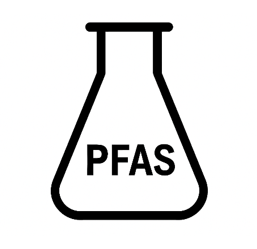
Significantly, the labeling mandate extends to products that are otherwise exempt from the state’s previously implemented PFAS reporting obligations and sales bans. For example, although fluoropolymers (a small subset of PFAS generally viewed as non-toxic) are exempt from these previous reporting requirements, they must now be labeled if intentionally added.
Industry groups have raised concerns about this discrepancy, noting that the labeling requirement treats all PFAS the same despite important distinctions in their chemistry. According to the American Chemistry Council, New Mexico’s uniform PFAS labeling “does not accurately reflect differences in hazard, exposure and potential risk,” and “misleading warning labels could unwittingly drive consumers to avoid low risk products.”
Expansive PFAS labeling may also heighten litigation exposure. Plaintiffs’ attorneys will have greater visibility into which products contain PFAS and may leverage that information to pursue personal injury or consumer protection claims.
In addition to labeling, New Mexico’s new rule (pending non-substantive finalization) phases out the sale of consumer products containing intentionally added PFAS. Starting January 1, 2027, the state will prohibit the sale of cookware, food packaging, dental floss, juvenile products, and firefighting foam. At the start of 2028, the list will expand to include carpets, cleaning products, cosmetics, textiles, and other designated products. The phase out culminates in 2032, when the prohibition will apply to all products containing intentionally added PFAS.
In Memoriam
It is with profound sadness that we share that our partner, colleague and friend Jad Davis passed away April 2.
Jad joined Shook in 2019 and quickly became an integral part of the Orange County office, which he led as managing partner from 2024-2026, only stepping down in January to become co-chair of the firm’s Environmental & Toxic Tort Litigation Practice. Jad contributed to prior issues of Material Concerns, both as a writer and editor.
“From the moment he arrived at the firm, Jad was a force for engagement, collaboration, excellence and camaraderie. He brought excitement and energy to each day and participated in every firm and office initiative with a high level of commitment,” said Madeleine McDonough, chair of Shook. “We extend our deepest condolences to Jad’s family and loved ones.”